

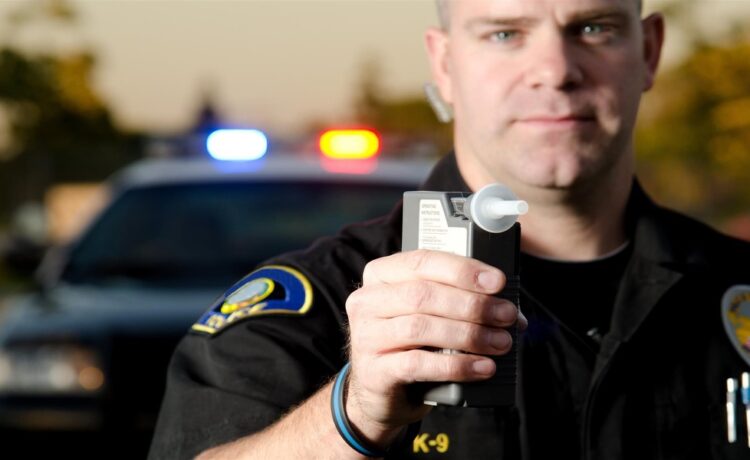
A driver pulled over on Route 1&9 in Jersey City after a late dinner. A motorist stopped on the Pulaski Skyway after a holiday party. A young professional pulled over on Kennedy Boulevard heading home from a Hoboken bar. The officer asks for a breath sample, and the instinct kicks in. Refuse the test. Force the State to prove the case without it. The Law Offices of Anthony Carbone has handled refusal cases throughout Hudson County for over 35 years, and the conventional wisdom that refusing the breathalyzer protects the driver is one of the most expensive misconceptions in New Jersey traffic law. The penalties for refusal track the penalties for an actual DUI conviction, often very closely, and the strategy that worked in other states does not work here.
The Implied Consent Statute
New Jersey’s implied consent law is codified at N.J.S.A. 39:4-50.2. The statute provides that any person who operates a motor vehicle on a public road in this state is deemed to have given consent to the taking of breath samples for chemical analysis when arrested for driving under the influence. The consent is implicit in the act of driving on New Jersey roads. A driver does not have the option to revoke that consent at the roadside without consequences.
The companion provision at N.J.S.A. 39:4-50.4a defines the offense of refusal and sets the penalties. A driver who refuses to submit to a breath test after being lawfully arrested for DUI faces a separate set of administrative and criminal consequences in addition to whatever the State can prove on the underlying DUI charge.
The two charges run together. A driver who refuses can still be convicted of DUI based on observation evidence, including erratic driving, slurred speech, the odor of alcohol, performance on field sobriety tests, and the officer’s observations during the arrest. The refusal does not block the DUI prosecution. It just adds a second charge with its own penalties.
What the Refusal Penalties Actually Look Like
A first-offense refusal in New Jersey carries license forfeiture, fines, mandatory installation of an ignition interlock device, surcharges, and required attendance at the Intoxicated Driver Resource Center. The forfeiture period and the interlock requirements were updated by the 2019 amendments to the DUI and refusal statutes, which moved away from outright license suspensions toward shorter forfeiture periods paired with longer interlock requirements.
For a first refusal where the driver’s BAC equivalent is presumed to be in the higher range, license forfeiture is generally calibrated to a period roughly equivalent to a high-tier first-offense DUI. Ignition interlock requirements run for a period after the forfeiture ends, often nine to fifteen months depending on the specifics of the case. Fines and surcharges add up to several thousand dollars when the Motor Vehicle Commission surcharges are factored in. Surcharges alone, payable to the MVC over three years following conviction, can reach $4,500.
A second refusal carries longer forfeiture, longer interlock, higher fines, and more significant collateral consequences. A third refusal escalates again, with mandatory jail time becoming a real possibility under the related sentencing guidelines.
The refusal penalties are not in lieu of the DUI penalties. A driver convicted of both faces consecutive license forfeiture periods in many circumstances, along with the combined financial penalties of both convictions.
The Difference Between Roadside and Stationhouse
Drivers sometimes refuse what they think is the breathalyzer when they are actually refusing a preliminary roadside test. The distinction matters legally. Portable breath tests at the roadside are typically used to support probable cause for arrest. Refusing a roadside test does not, in most cases, trigger the implied consent penalties.
The breath test that triggers the refusal statute is the formal evidential test administered at the police station, typically on the Alcotest 9510 instrument that has replaced earlier devices in most New Jersey police departments. That test is administered after arrest, after the officer has read the standard statement required by State v. Marquez and subsequent case law, and after the driver has had the opportunity to understand what is being asked.
Refusal at this stage is what produces the criminal and administrative consequences. The standard statement that the officer reads is itself often a contested issue at trial, because a defective reading can support a defense to the refusal charge. The statement has evolved over time, and challenges to its adequacy in any given case can sometimes change the outcome.
What Counts as a Refusal
The statute treats more than an outright “no” as a refusal. Anything less than unconditional consent to the test, repeated until the test is performed, can constitute a refusal. A driver who agrees to submit but then provides insufficient breath samples can be charged with refusal if the officer concludes the inadequate samples were intentional. A driver who asks to speak to a lawyer before deciding can be charged if the request is treated as a delay rather than a question seeking information. A driver who initially refuses and then changes their mind too late can still be charged.
These nuances trip people up because the situations rarely look like clear refusals. They look like confused drivers asking reasonable questions in a stressful moment. The statute is unforgiving, and the case law has tended to interpret these situations in the State’s favor more often than not.
Defenses That Sometimes Work
Refusal cases are not always lost causes. Several defenses come up regularly in New Jersey courtrooms. The legality of the underlying stop is the first. A stop without sufficient justification can suppress everything that follows, including the basis for the breath test request. The lawful arrest requirement is the second. The implied consent statute requires a lawful arrest, and probable cause failures can dismantle the refusal charge.
The standard statement defense is the third. The officer is required to read a specific statement informing the driver of the consequences of refusal. A reading that omits required information, that is delivered in a language the driver does not understand without a proper translation, or that fails to give the driver a real opportunity to respond can support a defense. Medical conditions that physically prevented the driver from providing an adequate sample can also support a defense in some cases, with appropriate medical documentation.
How The Law Offices of Anthony Carbone Approaches These Cases
The first phase of a refusal defense focuses on the procedural record. The motor vehicle stop, the field sobriety tests, the arrest, the standard statement, the actual administration of the test, and the documentation of the alleged refusal. Body camera footage, dash camera footage, and the police report are reviewed against the statutory and case law requirements.
Cases that are clearly winnable get fought through trial. Cases with weaker defenses are often handled through carefully negotiated dispositions that minimize the long-term consequences. The interlock period, the surcharge exposure, and the impact on driving privileges all matter to the client’s life going forward, and the defense work is calibrated to those realities rather than to a single all-or-nothing outcome.
The Next Step If You Are Facing a Refusal Charge
A driver in Jersey City, Newark, Hoboken, Bayonne, or anywhere across New Jersey facing a refusal charge should not assume the case is unwinnable simply because the conventional wisdom about refusal turned out to be wrong. The Law Offices of Anthony Carbone offers a free consultation to walk through the procedural record, the available defenses, and the realistic path forward. Reach out before the administrative deadlines run and before the early decisions in the case lock in consequences that are harder to address later.